
INTRODUCTION
Immigration is one of the most debated topics at the European level, having a significant impact on political, economic, and social agendas. The media plays a significant role in shaping public perceptions of this phenomenon, influencing public debate by selecting the perspectives from which events are reported. Previous studies have highlighted how the "refugee crisis" of 2015 marked a dramatic shift in the tone and themes covered by the media, transitioning from cautious tolerance and solidarity to security-focused discourse and fear-based narratives (Georgiou & Zaborowski, 2017).
In the current context, immigration remains a relevant topic; however, public perception varies depending on socio-political priorities. According to the 2024 Eurobarometer results, Romanians ranked immigration as the fourth most important issue facing the European Union, following the war in Ukraine, the domestic economic situation, and inflation. Nevertheless, media coverage of immigration in Romania is limited, and the available information suggests a constrained approach to the subject, emphasizing administrative and economic aspects over social or cultural ones.
This research aims to analyze how immigration is presented in Romanian mass media by exploring the dominant frames used in news reports on immigration published over two consecutive months of 2024. The study seeks to identify the main themes, tones, and secondary frames to better understand how public discourse on immigration is constructed in Romania. In a European context marked by an aging population and labor shortages, many countries attract skilled workers from abroad, despite political pressure from far-right parties that promote anti-immigration rhetoric. These contradictions highlight the complexity of the phenomenon and the importance of critically analyzing how the press contributes to shaping public opinion.
The present study is based on framing theory, a useful tool for understanding how media narratives are structured. The analysis of immigration framing in Romanian media contributes significantly to the academic literature, complementing previous research on immigration representation in European media and offering a local perspective on a global issue.
I. CONCEPTUAL DELIMITATIONS I.1. Framing Theory
To analyze how immigration and immigrants are represented in Romanian media, we will employ framing theory, which Robert M. Entman defines as the process of "selecting some aspects of a perceived reality and making them more salient in a communicative text in such a way as to promote a particular problem definition, causal interpretation, moral evaluation, and/or treatment recommendation for the described element" (Entman, 1993).
Focusing on the media, beyond the explicit information presented in a news report, framing includes "frames" that influence how the public interprets an event or issue, significantly impacting beliefs, attitudes, and behaviors (Tewksbury & Scheufele, 2019). In the theoretical chapter on framing and its applications in "Media Effects: Advances in Theory and Research" (2019), Tewksbury and Scheufele go even further, arguing that effective framing can structure the meaning of a message even in the absence of explicit information by relying on norms, values, and cultural meanings.
The representation of migration and immigrants in Romanian media can be analyzed through the lens of framing theory, which highlights how the media not only informs but also influences public perceptions by presenting factual data from various "angles" (perspectives). Thus, the media does not merely reflect reality but actively shapes it, creating an interpretative context that can profoundly influence social and political debates.
The lack of a unified system for identifying framing patterns across various public policy domains was addressed by Amber E. Boydstun, Justin H. Gross, et al. (2013) through the creation of the "Policy Frames Codebook," a tool for analyzing the framing of public policy issues. This manual provides a classification system for frames applicable to diverse policy-related problems, designed to be specialized according to the characteristics of each subject. The manual includes fourteen types of frames applicable to any policy issue (e.g., abortion, immigration, foreign aid) and in any communication context. The following frames are particularly relevant to the current analysis (Boydstun, Gross, Resnik, & Smith, 2013):
• Economic frames: Costs, benefits, or financial/monetary implications of the issue;
• Capacity and resources frames: The availability or lack of resources or the capacity of existing systems and resources to meet policy objectives;
• Moral frames: Any perspective, political objectives or actions (including proposed actions), determined by ethical considerations or social responsibility;
• Law and order, crime, and justice frames: Specific policies applied in practice and their implementation, incentives, and implications. This includes reports on the enforcement and interpretation of laws by individuals and authorities, legal violations, legislative loopholes, fines, sentences, and punishments, as well as crime trends;
• Security and defense frames: Security, threats to security, and the protection of individuals, families, groups, or nations;
• Health and safety frames: Access to medical services and their effectiveness, prevention or perpetuation of gun violence, infrastructure, and building safety;
• Quality of life frames: The effects of a policy on individual wealth, mobility, access to resources, happiness, social structures, daily routines, and community life quality;
• Cultural identity frames: Social norms, trends, values, and customs related to a specific policy issue;
• Public opinion frames: References to general social attitudes, surveys, and demographic information, as well as the implicit or actual consequences of deviating from public opinion or survey results;
• Political frames: Political considerations related to an issue;
• External regulation and reputation frames: Romania’s external relations with another nation, international relations between states, or inter-group relationships.
Given the relevance of the framing types theorized by Semetko and Valkenburg (2000) for the present study and their frequent use in the analysis of migration-related messages, we highlight the following frame types:
• Conflict frames: Emphasize conflicts between individuals, groups, institutions, or countries;
• Human interest frames: Highlight an individual's story or an emotional perspective on presenting an event, subject, or issue;
• Responsibility frames: Present an issue or situation in a way that assigns responsibility for causing or resolving it to either the government, an individual, or a group.
The authors also mention that any communication material can contain a primary frame along with additional ones. For example, a message focusing on the economic impact of immigration but also discussing challenges related to immigrants' quality of life and cultural assimilation would encompass three frame types, economic, quality of life, and cultural identity (Boydstun, Gross, Resnik, & Smith, 2013).
I.2. Migration
A general definition of migration describes the concept as "the movement of people from their usual place of residence, either by crossing an international border or within a state" (IOM, 2019). Thus, there are two types of migration: internal migration, which refers to the movement of people within their country of origin, and international migration, where individuals reside in another country.
This study focuses primarily on international migration, as the domestic media often refer to foreign immigrants entering Romania using the term "migrants." In the context of international migration, a migrant is defined as "any person who moves or has moved across an international border (...), away from their usual place of residence, regardless of: (1) their legal status; (2) whether the movement is voluntary or involuntary; (3) the reasons for the movement; or (4) the duration of stay" (IOM, 2019).
Migration occurs in two main directions: emigration, which refers to individuals leaving a country or region, and immigration, which involves their arrival in another country or region. Migration can be classified into voluntary migration, which occurs when individuals relocate by choice for economic, social, or educational reasons, and forced migration, in which individuals are compelled to leave due to factors such as armed conflicts, persecution, or natural disasters. While voluntary migration involves free decision-making, forced migration is driven by factors that threaten life or safety. However, the distinction between these two categories is often blurred, as extreme economic conditions or political instability can blend voluntary and forced elements, complicating policy and humanitarian responses (Dragojević, 2019).
Migrants are classified into distinct categories based on the causes and destination of their movement, as well as their legal status in the host country (Tsegay, 2023). Since the reasons for migration are complex and cannot always be neatly categorized, there are also deficiencies in how migrants are managed in destination countries, due to gaps in existing policy documents. For example, according to the 1951 UN Convention Relating to the Status of Refugees, refugee status can only be granted to individuals with "a well-founded fear of being persecuted for reasons of race, religion, nationality, membership in a particular social group, or political opinion." This definition does not allow flexible interpretations and excludes many contemporary migration challenges (e.g., war, generalized violence) (Irod, 2024). As a result, complementary and temporary protection mechanisms have been adopted to provide support for individuals in need of international protection who do not meet the strict criteria for refugee status. However, these mechanisms are not universally applicable, and in some cases, access to the host country is denied.
For this research, news articles addressing immigration to Romania in all its subcategories will be considered, regardless of the underlying reasons, the legal status of individuals, or the degree of legality.
II. LITERATURE REVIEW
In a study examining the relationship between the media agenda and the parliamentary agenda regarding immigration and integration in the Netherlands, Vliegenthart and Roggeband (2007) analyzed the frames used in politics and the press between 1995 and 2004. The results highlighted a long-term bidirectional influence between the two spheres, although short-term influence was limited. Major shifts, such as the abandonment of multiculturalism in favor of restrictive policies after the 1998 elections and the growing "Islam as a threat" narrative post-9/11, significantly reshaped public and political debate (Vliegenthart & Roggeband, 2007).
Although frame analysis in public communication about migration in Europe was relatively underdeveloped at the beginning of the 21st century, the increase in immigration from the second half of the first decade exponentially heightened interest in understanding how newcomers were portrayed and perceived by public opinion (Jakob-Moritz et al., 2018). The intensification of migration flows in the early 2010s and even the doubling of arrivals in consecutive years - for instance, 60,000 arrivals in 2013 compared to 130,000 in 2014, brought migration to the forefront.
At the beginning of 2015, Alexander Caviedes (2015) analyzed how the press in the UK, France, and Italy framed immigration and migrants, evaluating the prevalence of security and economic narratives. The results suggested that, at the time of the study, a dominant securitization meta-narrative had not yet emerged in the European press. Direct references to physical threats or crime were rare, except for border-related discussions, which appeared more frequently. The study also highlighted significant national variations in the prioritization of economic versus security concerns, emphasizing the complexity of migration narratives in the European media (Caviedes, 2015).
Without contesting Caviedes' findings, subsequent studies on immigration framing during the refugee crisis in other European countries identified security frames as predominant. The divergence in conclusions may be due to different national contexts and variations in media discourse across European countries. Additionally, when Caviedes’ study was published (February 2015), the refugee crisis had not yet reached its peak. A recent analysis of Czech and Slovak media coverage (2013–2016) before and during the EU refugee crisis found that security frames were the most frequently used, whereas victimization frames were much less common. Economic and administrative frames appeared more frequently in quality media, while tabloids predominantly employed security and cultural frames. The overall tone was predominantly negative, with security and cultural frames being the most negatively charged. Moreover, political actors dominated media narratives, while immigrants and refugees were almost invisible as direct sources in news reports (Kovář, 2023).
Chouliaraki and Zaborowski (2017) analyzed how the 2015 refugee crisis was covered in the press across eight European countries, identifying a strong tendency to emphasize the negative consequences of hosting refugees. 58% of news articles focused on four types of arguments against refugees: geopolitical (fear of terrorism), economic (fear of financial crisis), cultural (fear or antipathy toward Islam), and moral (fear of deception). Recent studies reinforce these findings, identifying four dominant media frames in Southern Europe: normalization, victimization, social burden, and threat. Negative frames (depicting migrants as either a burden or a threat) increased significantly between 2014 and 2019 (The Conversation, 2025).
Regarding the framing of the refugee crisis in Romanian media, a study by Vincze, Meza, and Balaban (2020) analyzed news articles from six leading Romanian publications (three quality newspapers and three tabloids) between 2015 and 2017. The study identified six primary and six secondary frames: European crisis, context/victimization, relocation/distribution, international conflict, social issue, national costs, religious themes, U.S. immigration policy, humanitarian/international. The results supported the broader European trend of migration securitization, while also highlighting regional specificity, with a strong emphasis on the crisis as a European problem, a characteristic feature of media coverage in Central and Eastern Europe (Vincze, Meza, & Balaban, 2021).
Beyond general migration narratives, some researchers have focused on specific types of migrants and cultural minorities. A 2016 study (Kroon, Kluknavská, Vliegenthart, & Boomgaarden) examined Roma representation in the media across the Netherlands, Germany, Slovakia, the Czech Republic, and the UK, exploring how stereotypes and discrimination are reflected or reinforced. The study revealed a dual framing, portraying Roma as both victims and perpetrators, with differences largely depending on media sources and newspaper types (Kroon et al., 2016). In 2017, Meeusen and Jacobs (2017) found that Roma were more frequently framed as an economic threat, whereas North Africans were more often depicted as a cultural threat, contrasting with Eastern Europeans.
Balch and Balabanova (2014) analyzed public debates in the UK on Romanian and Bulgarian migration within the EU (2006–2013), showing a dominance of social chauvinism, alongside increased security-related arguments and a decline in economic nationalist rhetoric (Balch & Balabanova, 2014).
Thus, outside the peak period of the 2015 refugee crisis, the analysis of how migration is portrayed in the Romanian media has been limited. Most studies focus on representations in European media, highlighting the predominance of security, economic, and cultural frames, depending on the national context and the specific time frame analyzed.
Although regional analyses indicate a general trend toward securitization, Romania’s local specificities remain underexplored. This study aims to address this gap by providing a more comprehensive understanding of migration narratives in the Romanian press.
III. CASE STUDY, THE PORTRAYAL OF IMMIGRANTS IN THE ROMANIAN PRESS III.1. Methodology
This research employs a mixed-method approach, focusing on a content analysis of all news articles identified during the period August 15, October 15, 2024, alongside the identification and analysis of attributes used in relation to immigration and immigrants. The selected period precedes the start of the presidential election campaign, to avoid potential influences from electoral-driven public discourse.
Research Questions
1. What frames are used in Romanian press coverage of immigration and immigrants?
2. What is the predominant tone (positive/negative/neutral) in Romanian media messages concerning immigration and immigrants?
3. What are the main attributes assigned to immigrants and immigration in the Romanian press?
Research Objective The objective of this study is to gain a comprehensive understanding of how immigration is portrayed in the Romanian media, contributing to a well-founded response to the research questions.
Research Design The identification of news articles will be based on the selected time frame, using keywords such as "immigrant," "migrant," "refugee," "immigration," and "migration." Each article will then be analyzed to identify the frames used, both the primary frame and any secondary frames.
The frames employed in this content analysis have been predefined based on existing scholarly literature, ensuring a clear and consistent operationalization. The selected frames align with those described in Chapter I of this study. Therefore, the approach is primarily deductive, investigating frames that are defined and operationalized prior to conducting the research.
Each article will be analyzed to determine its tone, whether positive, negative, or neutral, in relation to immigrants, immigration, and related issues. Additionally, the attributes used to characterize immigration and immigrants will be extracted, and their frequency will be measured.
III.2. Content Analysis, Immigration in the Romanian Media
During the selected period, 19 news articles addressing immigration and/or immigrants in Romania or the European Union (EU) were identified. Articles covering Romanian emigration, immigration to other EU countries, or other migration-related topics unrelated to immigration in Romania were excluded.
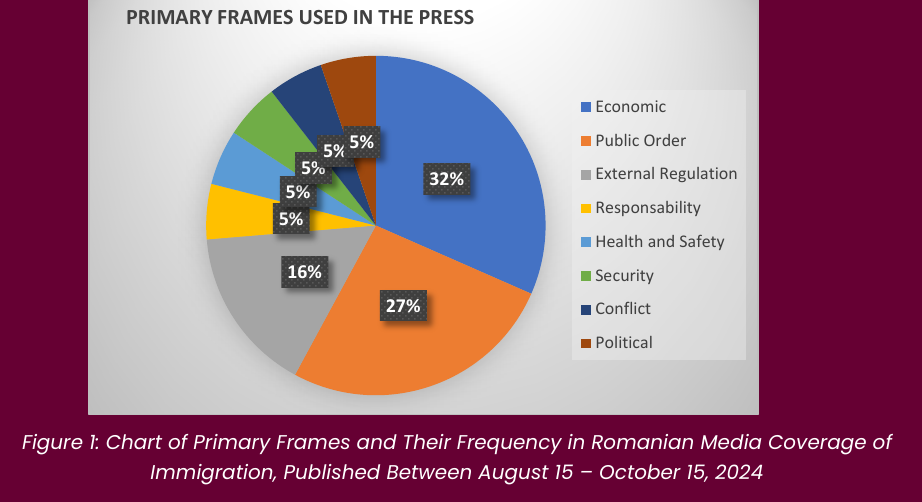
Following the content analysis of immigration-related news, the economic frame emerged as the most frequently identified primary theme (see Figure 1). The tone associated with this frame is generally positive, approximately 16% of the articles have a negative tone, while 50% are positive and the remainder neutral. Most articles in this category discuss labor migration, which is perceived as a solution to the current workforce shortage.
Text extracted from the illustration
PRIMARY FRAMES USED IN THE PRESS Economic 5% Public Order 5% 5% 32% External Regulation 5% Responsability 5% Health and Safety 16% Security 27% Conflict Political Figure 1: Chart of Primary Frames and Their Frequency in Romanian Media Coverage of Immigration, Published Between August 15, October 15, 2024
The secondary frames used in the news discussing migration in relation to the economic sector include public opinion, capacity and resources, responsibility, human impact, and quality of life. Specifically, reports on immigration from an economic perspective mention aspects related to capacity and resources, such as the importance of distributing state resources in response to demographic and social changes caused by migration to achieve the best economic and social outcomes, the shortage of human resources in the domestic labor market, and available jobs for Ukrainian refugees.
News covering immigration from an economic perspective is also the most likely to use the human impact frame (approximately 33%), highlighting the difficulties immigrants face in their country of origin, the complexity of reaching Romania, and the challenges they encounter, as well as specific experiences of immigrants in Romania. However, the focus on individual immigrant stories and their individual experiences is relatively low in the total number of news reports (21%), with most articles discussing migration in general terms without bringing specific cases to the forefront.
After the economic frame, immigration is often presented through the public order frame, appearing in about 27% of the identified news reports. Most articles refer to the actions of Romanian law enforcement to combat illegal immigration at the borders by detecting unauthorized entry attempts, as well as DIICOT and DNA operations related to crimes committed by authorities responsible for managing immigration, dismantling transnational illegal migration networks, arrests, and sentencing. In these reports, all references pertain to the illegal side of migration, with 80% using a negative tone and 20% a neutral tone. The secondary frames used in these cases are responsibility, security, and economic factors. The responsibility frame is used to assign the duty of combating illegal migration to Romanian authorities, particularly the Border Police, while the economic frame justifies migration as a result of immigrants’ financial needs. Security is used in a secondary manner, not to portray immigrants as a threat to Romania, but to shift the focus onto migrant smuggling networks and related crimes.
External regulation and reputation constitute a frame used in 16% of the analyzed news reports, either to attribute migration management to international organizations (such as UNHCR and the European Commission) or to highlight Romania’s improved reputation within the EU in terms of economic attractiveness for immigrants. 66% of the news reports have a positive tone, using human impact and public opinion frames to justify the acceptance of immigrants through their difficult life experiences and public attitudes/perceptions on the topic. The negative tone (one-third of the reports) was not directed at immigration itself but rather at EU-level political processes leading to stricter measures in this area.
Other primary frames used equally include health and safety and responsibility, which present cases of refugees receiving medical treatment in Romanian hospitals and attribute the decline in illegal crossings in 2024 to European-level measures, particularly agreements with countries of origin and transit, as well as FRONTEX operations. Political and conflict frames are used exclusively to describe the contentious political dynamics within the EU regarding immigration and the opposition of organizations advocating for immigrant rights against increased border monitoring through the acquisition of surveillance equipment.
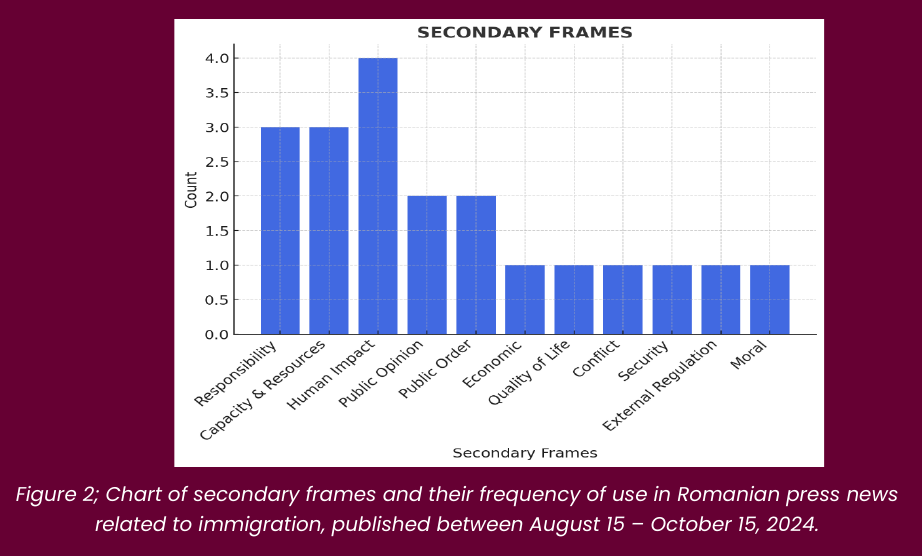
Regarding the secondary frames, illustrated in Figure 2, there is a noticeable dominance of human impact mentions, suggesting a tendency to incorporate emotional aspects or individual stories into the articles. Although in the news where this frame is present, there is an attempt to "humanize" the topic of immigration, the number of such articles is relatively low (4 out of 19), indicating a prevalence of perceiving immigration more as a statistically described phenomenon rather than highlighting the causes, difficulties, and challenges that immigrants face in their country of origin, during their journey, and in the host country.
Text extracted from the illustration
Figure 2; Chart of secondary frames and their frequency of use in Romanian press news related to immigration, published between August 15, October 15, 2024.
The secondary frames of responsibility and capacity & resources, with three mentions each, are used to support the main arguments of the news or to contextualize immigration-related challenges, primarily by assigning responsibility for detecting and addressing illegal immigration to Romanian authorities or by referring to labor market conditions, such as the shortage of human resources and the prevalence of foreign workers.
The low frequency of the moral frame, as well as those of external regulation, security, conflict, and quality of life, suggests that these aspects are addressed only occasionally and likely in specific contexts. For example, the economic frame is mentioned only marginally, which may reflect either a deliberate omission or the perception that it is not sufficiently relevant compared to other dimensions. The limited mention of the moral frame (one occurrence) indicates minimal attention to ethical aspects in the analyzed articles, with no connections made between moral norms and the management of immigration. The external regulation frame has a low presence as a secondary frame, unlike as a primary one, suggesting that international relations or external perspectives on immigration are covered by the press only when discussing EU-level migration dynamics.
Overall, immigration does not seem to be a major topic in the Romanian press, being mainly covered because of events such as the detection of illegal immigrants at the border, actions taken by Romanian authorities, as well as surveys, opinions, and positions of EU leaders and institutions. Unlike findings from previous studies on immigration framing in the European media, no trend toward securitization of discourse has been identified. In news where the primary frame is public order or security, there are no explicit mentions of threats posed by immigration or immigrants.
Text extracted from the illustration
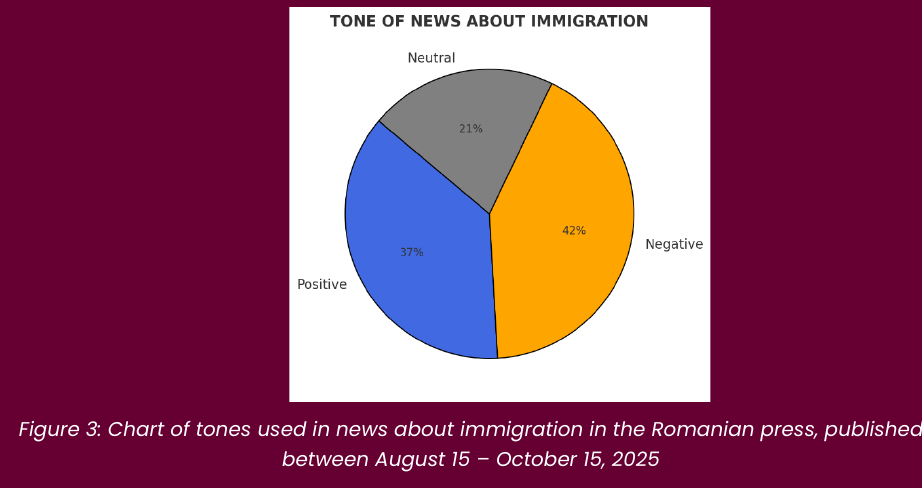
Figure 3: Chart of tones used in news about immigration in the Romanian press, published between August 15, October 15, 2025
For the most part, news articles refer to illegal migration, often triggered by official statements from authorities about border detections or dismantling of trafficking networks, which explains why 42% of the reports have a negative tone. However, it is noteworthy that the negative tone is not directed at immigrants or their actions but is rather applied "by default" in topics describing crimes, including illegal migration.
Press publications are predominantly characterized by the economic frame, highlighting the frequent association of immigration with labor market participation and other workforce dynamics. The limited presence of the human impact frame, which would emphasize specific details of immigrants' experiences, reinforces the notion that immigration is not perceived as a phenomenon driven by conditions in the country of origin but rather by the opportunities and attractiveness of the host country.
Terms discussed by the author in the analysis accompanying the figure, for news published between 15 August and 15 October 2024.
- illegal
- fraudulent
- opportunity
- profitable
- hardworking
- cheap
- unskilled
- Asian
- Afro-Asian
- foreigner
- impressive
- incredible
- vulnerable
- dependent
- sacrificed
In Figure 4, the "word cloud" of attributes used in the analyzed news reports is presented, with the observation that these terms primarily describe illegal immigration, given its prevalence in media coverage, as well as immigrants themselves. An analysis of the extracted words reveals a duality in the portrayal of immigration in Romanian media.
Terms such as "illegal" and "fraudulent" indicate a negative association and an emphasis on problematic aspects related to migration.
In contrast, terms that highlight the positive contributions of immigrants, such as "opportunity," "profitable," or "hardworking," suggest recognition of their economic value, particularly in labor-deficient sectors. Additionally, descriptors like "cheap" or "unskilled" indicate a perception of immigrants as an accessible and useful workforce, though sometimes undervalued.
From a cultural perspective, references to the origin of immigrants, such as "Asian" or "Afro-Asian," reflect prevailing perceptions about their predominant regions of origin and a subtle distinction of an "us vs. them" narrative, further reinforced by the frequent use of the term "foreigner." However, expressions like "impressive" or "incredible" also suggest a degree of positive recognition of immigrants' experiences throughout their journey.
Furthermore, immigrants are sometimes portrayed as "vulnerable," "dependent," or "sacrificed," indicating concern for the difficult conditions they face. Expressions like "treated" and "cared for" point to an awareness of their need for protection and support. However, reports containing such terms are relatively few, highlighting a lack of interest in aspects such as integration and quality of life, which are marginalized in comparison to statistics on the number of individuals entering the country and their economic contributions.
IV. CONCLUSIONS
The present study underscores that immigration is an intermittently covered topic in Romanian media, predominantly framed within economic and public order contexts. The economic frame is the most frequently employed, reinforcing the correlation between immigration, labor shortages, and employment market dynamics. The prevailing tone within this frame is predominantly positive, underscoring the role of immigrants as economically valuable actors. However, their representation remains largely instrumental, often neglecting significant social and humanitarian dimensions.
Although certain news articles incorporate elements of human impact and attempts to "humanize" the migration phenomenon, such framing remains relatively infrequent. Individual narratives and detailed accounts of immigrant experiences are marginal, indicating a media approach that prioritizes statistical data and general trends over the socio-emotional facets of immigration. The recurrent use of the public order frame highlights a predominant focus on irregular migration and law enforcement measures addressing this issue. Nonetheless, the discourse does not exhibit characteristics of securitization, as immigrants are not explicitly portrayed as a direct threat; rather, the negative tone is predominantly associated with criminal activities, such as the dismantling of trafficking networks or the detection of unauthorized border crossings.
Frames related to external regulation, institutional responsibility, and other secondary perspectives emerge sporadically, primarily in specific contexts such as international relations or the governance of immigration within European policies. Ethical considerations and moral dimensions concerning immigration are largely absent, reflecting a limited focus on immigrant integration and quality of life. Furthermore, lexical analysis of media discourse reveals a dualistic portrayal of immigration: on the one hand, immigrants' economic contributions are acknowledged, while on the other, challenges associated with irregular migration and its associated complexities are emphasized.
In summary, this analysis suggests that Romanian media predominantly constructs immigration as an economic and administrative issue rather than a multifaceted sociocultural phenomenon. The integration of immigrants and considerations related to their quality of life remain peripheral in media narratives, underscoring the necessity for a more comprehensive and balanced journalistic approach to immigration discourse.
BIBLIOGRAPHY
Balch, A., & Balabanova, E. (2014). Ethics, Politics and Migration: Public Debates on the Free Movement of Romanians and Bulgarians in the UK, 2006–2013. Politics, 19-25.
Boydstun, A. E., Gross, J. H., Resnik, P., & Smith, N. (2013). Identifying Media Frames and Frame Dynamics Within and Across Policy Issues. New Directions in Analyzing Text as Data Workshop, London. Preluat pe 01 04, 2025, de pe https://faculty.washington.edu/jwilker/559/frames-2013.pdf Caviedes, A. (2015). An Emerging ‘European’ News Portrayal of Immigration? Journal of Ethnic and Migration Studies , 897-917 .
Chouliaraki, L., & Zaborowski, R. (2017). Voice and community in the 2015 refugee crisis: a content analysis of news coverage in eight European countries. International Communication, 613-635.
Dragojević, M. (2019). Migration, Revisiting the Concepts of Forced and Voluntary. ASN World Convention. Columbia University 2.
Entman, R. M. (1993). Framing: Toward Clarification of A Fractured Paradigm. Journal of Communication, 51-58.
Georgiou, M., & Zaborowski, R. (2017). Media coverage of the “refugee crisis”: A cross-European perspective . Council of Europe.
IOM. (2019). Who Is a Migrant? Preluat pe 01 06, 2025, de pe https://www.iom.int/who-is-a-migran Irod, R. G. (2024, 08). Limitele și constrângerile Convenției privind Refugiații. România: Centrul pentrru Studiul Dezvoltării Internaționale și Migrației . Preluat de pe https://dim.politice.ro/wp-content/uploads/2024/08/EC-2024.-5-romana.pdf Jakob-Moritz, E., Meltzerb, C. E., Heidenreicha, T., Herreroc, B., Theorind, N., Fabienne, L.. . . Strömbäck, S. (2018). The European media discourse on ff immigration and its e ects: a literature review. ANNALS OF THE INTERNATIONAL COMMUNICATION ASSOCIATION, 207 - 223.
Kovář, J. (2023). Media framing of immigrants in Central Europe in the period surrounding the refugee crisis: Security, negativiy, and political sources. Communications, 5-27.
Kroon, A., Kluknavská, A., Vliegenthart, R., & Boomgaarden, H. G. (2016). Victims or perpetrators? Explaining mediaframing of Roma across Europe. European Journal of Communication, 375-395.
Meeusen, & Jacobs. (2017). Television News Content of Minority Groups as an Intergroup Context Indicator of Differences Between Target-Specific Prejudices. Mass Communication and Society, 213–240.
OIM. (2019). Glossary on Migration. International Migration Law. 2019. (A. C.
Sironi, & E. M., Ed.) Geneva. Preluat de pe file:///C:/Users/AA/Downloads/IML_34_Glossary.pdf Semetko. H., & Valkenburg, P. M. (2000). Framing European politics: A content analysiss of press and television new. Journal of Communication, 93-10.
Tewksbury, D., & Scheufele, D. (2019). News Framing Theory and Research. În B. J., & M. Oliver, Media effects: Advances in theory and research. Hillsdale: Erlbaum. The Conversation. (2025, 07 5). Criminals, terrorists and freeloaders: how migrants are portrayed in the European media. Preluat de pe https://theconversation.com/criminals-terrorists-and-freeloaders-how-migrants-are-portrayed-in-the-european-media-208524 Tsegay, S. M. (2023, 08 26). International Migration: Definition, Causes and Effects. Basel, Elveția. Preluat pe 01 06, 2025, de pe file:///C:/Users/AA/Downloads/genealogy-07-00061.pdf van Gorp, B. (2005). Where is the Frame? Victims and Intruders in the Belgian Press Coverage of the Asylum Issue. European Journal of Communication, 484–507.
Vincze, H. O., Meza, R., & Balaban, D. (2021). Frame Variation in the News Coverage of the Refugee Crisis: The Romanian Perspective. East European Politics and Societies, 113 - 135.
Vliegenthart, R., & Roggeband, C. (2007). Framing immigration and integration. International Communication Gazette, 295-319.