
Introduction
Illegal migration represents a global challenge, with multiple implications for international security, the economies of the countries involved, and human rights. The United Nations plays a central role in combating migrant smuggling through the adoption of international legal instruments aimed at preventing, discouraging, and sanctioning the illegal activities of smuggling networks. Addressing this issue in the context of current phenomena is especially justified due to the terminological ambiguities and conceptual overlaps between human trafficking and migrant smuggling, elements clarified in the specialized literature and in migration and international relations analyses.
This analysis focuses on the period between 2015 and 2021, marked by a significant intensification of migration from North Africa to Europe. Political instability, conflicts, and socio-economic problems in the Maghreb region (Morocco, Algeria, Libya, Tunisia) have favored the expansion of migrant smuggling. The year 2015 was a key moment, marking the beginning of the most severe refugee crisis since World War II, when hundreds of thousands of people attempted to cross the Mediterranean Sea under dangerous conditions, using routes through this region. During the same period, UN bodies such as UNHCR and IOM intensified their efforts in the region by implementing protection programs, border management strategies, and measures to combat migrant smuggling. Additionally, the Valletta Action Plan (2015) and regional initiatives coordinated under the UN’s aegis aimed specifically to strengthen the institutional resilience of Maghreb states in order to cope with these pressures. Therefore, the choice of the 2015–2021 interval is justified by the density of events related to illegal migration and the relevance of international efforts to combat this phenomenon within a fragile but evolving institutional framework.
The Conceptual Framework of Illegal Migration
Migrants are often reduced to mere numbers in statistics, subjects for legislative reports, or security threats in the eyes of border police. Beyond these formalities, the essence and human side of the migrant is lost, becoming just a percentage in the annual reports of international organizations. Due to disproportionate global development, the difficulties faced by citizens in low-income countries push them to seek better opportunities in more developed nations (Castles et al., 2012, pp. 118–122). As a result, international migration and the detachment from one’s home country have become increasingly common among individuals and families aspiring to a better life and personal security (Ibid., p. 130).
According to the International Organization for Migration (IOM, 2025), illegal migration refers to the crossing of international borders by individuals without complying with the legal norms imposed by the destination state. This can take two main forms: voluntary migration, primarily driven by economic factors, and forced migration, triggered by armed conflicts, persecution, or natural disasters. Within the European context, terminological debates persist, particularly regarding the distinctions between migration, trafficking, and smuggling. The liberalization of borders and the adaptation of national policies have led to the institutional use of the term "migrant smuggling" to designate actions that involve facilitating the illegal entry of individuals into EU member states (INTERPOL, 2025).
International migration has increased exponentially in recent years, and the number of routes into European countries has grown significantly. For instance, the Maghreb region is considered one of the most dangerous migration routes globally, used by both economic migrants and refugees from conflict zones such as Libya or South Sudan. Studies show that thousands of migrants lose their lives annually while attempting to cross the Mediterranean Sea to reach Europe, whether in search of asylum or to reunite with family members already settled on the continent. According to data from the International Organization for Migration, during 2016–2017, the Central Mediterranean route was considered the most dangerous in the world, with hundreds of deaths recorded monthly during sea crossings, especially off the coast of Libya (IOM, Missing Migrants Project). In July 2015 alone, over 100 bodies were found along the Libyan coast, despite no major shipwrecks being recorded in the preceding months, underscoring the extreme danger of this route (Ibid.).
Furthermore, according to data provided by Frontex, between 2017 and 2019, traffickers earned over 330 million euros from illegal activities linked to migration (Frontex, 2019). Europol estimated in 2016 that approximately 90% of migrants who crossed European borders illegally had used the services of an organized smuggling network (Europol, 2016). Thus, an analysis of these routes and risks cannot be complete without understanding the role of traffickers, who turn each migration journey into a financial transaction, often resulting in abuse, exploitation, or even loss of life (UNODC, 2024).
The Difference Between Human Trafficking and Migrant Smuggling
The distinction between human trafficking and migrant smuggling is essential for understanding the core of the subject, as well as the terminological dilemmas and conceptual misunderstandings. According to the UN Protocol against the Smuggling of Migrants (2000), human trafficking involves the forced exploitation of individuals, whereas migrant smuggling refers to the facilitation of illegal border crossings for financial gain (INTERPOL, Human Trafficking and Migrant Smuggling, 2025).
The term “migrant smuggling” was initially used to describe behaviors related to facilitating unauthorized entry into a country and, at times, unauthorized stay. As such, “migrants are often unaware that those guiding them are actually human traffickers, thereby exposing themselves to considerable risk” (UNODC, What Is Migrant Smuggling?, 2025). Over time, the term was legally adapted in line with the approaches promoted by UN agencies, in order to propagate and adopt this terminology globally and to clearly distinguish between the two concepts.
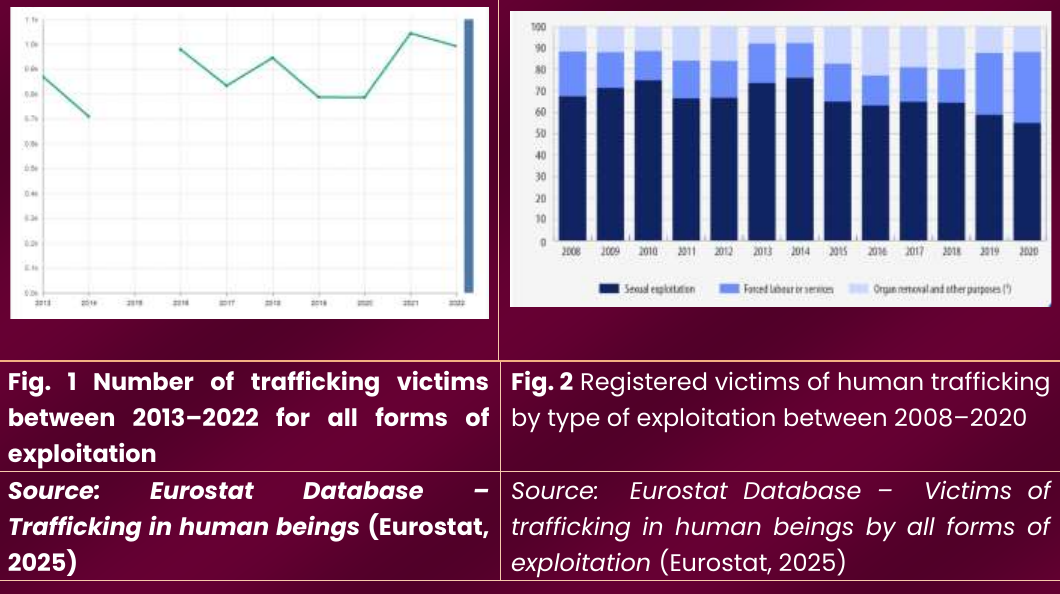
The differences can also be seen numerically. According to Eurostat data on victims of human trafficking in Europe, across all forms of exploitation, there has been a fluctuating increase both in the number of cases (Fig. 1) and in the purposes for which individuals were trafficked between 2008 and 2020 (Fig. 2). Maritime entry into Europe remains the most common route, used by migrants from the southern part of the continent (via the Maghreb- Mediterranean route), as well as from various Asian countries.
According to UNODC, 90% of migrants who arrive illegally in Europe rely on organized smuggling networks, which charge fees ranging from €1,500 to €10,000, depending on the chosen route and the level of risk involved in the transit (Frontex, 2025).
Text extracted from the illustration
Fig. 1 Number of trafficking victims Fig. 2 Registered victims of human trafficking between 2013–2022 for all forms of by type of exploitation between 2008–2020 exploitation Source: Eurostat Database, Source: Eurostat Database, Victims of Trafficking in human beings (Eurostat, trafficking in human beings by all forms of 2025) exploitation (Eurostat, 2025)
UN mechanisms for combating Migrant Smuggling
Through the United Nations, many traffickers are identified, prosecuted, and imprisoned based on violations of the UN Charter. Beyond the illegal gains, abuse, and robbery stemming from the luring and exploitation of migrants, such practices also infringe upon the fundamental UN principles of safety and security, as outlined in Article 2(3) of the Charter. For this reason, a three-part analysis is necessary to understand the dynamics between the victims, the institution, and the traffickers (UNODC, What Is the Role of Organized Crime Groups in Migrant Smuggling?).
The rescue and compensation of smuggled migrants can be contested in court by traffickers, who often invoke the migrants' initial consent to the journey. This argument complicates legal proceedings, as courts are then challenged to distinguish between apparent consent and the actual abuse or coercion exercised later (IOM, Countering Migrant Smuggling).
To better understand the UN measures taken between 2015 and 2021, it is important to briefly highlight the preexisting legal context that laid their foundation (United Nations, 2000). UN-led discussions aimed at adopting documents to discourage the phenomenon emerged at the end of the 20th century, culminating in the year 2000 with the adoption of the Protocol Against the Smuggling of Migrants by Land, Sea and Air. This protocol is rooted in the United Nations Convention against Transnational Organized Crime, which aimed to reduce all forms of criminal activity, not just illegal migration. These instruments laid the formal groundwork for preventing the activities of traffickers who profit from their victims. Moreover, the protocol encourages member states to criminalize migrant smuggling by penalizing actions that enable individuals to remain in a country where they are not legal residents, in violation of the host country’s regulations (IOM, Countering Migrant Smuggling, p. 2).
International Legal Framework
The United Nations has adopted several legal instruments to combat migrant smuggling, including:
• The UN Protocol Against the Smuggling of Migrants (2000), part of the Palermo Convention on Transnational Organized Crime (United Nations, 2000).
• UN Security Council Resolution 2331/2016 on combating human trafficking, which highlights the links between illegal migration and terrorist groups (S/RES/2331, 2016).
• Regional agreements on border security, such as the cooperation between Frontex and North African states, which intensified during the proposed analysis period. For example, in 2019, Frontex collaborated with Moroccan authorities to develop a maritime surveillance system aimed at reducing illegal migration flows to Spain, particularly along the Western Mediterranean route (IOM, 2019, p. 12).
Initiatives and Action Plans
Between 2015 and 2021, the UN implemented several initiatives aimed at preventing illegal migration, including:
• The Global Compact for Migration, an international treaty signed by over 160 countries (Global Compact, 2016).
• Frontex operations, focused on intercepting illegal vessels in the Mediterranean.
• UN-EU partnerships, aimed at dismantling trafficking networks and protecting migrants at risk.
Case Study Summary: The Maghreb Region (Morocco and Algeria)
The African continent faces ongoing issues related to migrant smuggling due to the availability and readiness of traffickers to guide and direct migrants toward European countries. In this regard, recent analyses contradict the assumptions and hasty generalizations often made about the region’s migration dynamics: “the truly large flows of migrants, especially trafficked migrants, do not originate from Africa” (GMDAC, 2017, p. 1). Data instead point to the Middle East and Asia as the primary points of origin for most illegal migration flows (Ibid., pp. 2–3).
What makes the Maghreb a unique region in the context of human trafficking is the consistent effort by local authorities to limit the phenomenon, despite having limited resources. Even with restricted means, the governments of Maghreb countries, supported by international organizations, have adopted public policies aimed at controlling and preventing the expansion of trafficking networks (Ibid.). Still, in the absence of well-synchronized administrations, the desire for cooperation and problem-solving remains strong, as security and defense are vital in high-risk areas where law violations are frequent. Countries in the Maghreb region have signed multiple cooperation agreements with the European Union to contain the phenomenon, receiving in return support for economic development projects and border reinforcement.
Between 2015 and 2021, bilateral collaborations between European and North African states intensified. For example, Italy actively cooperated with Libya, supporting the Libyan Coast Guard through training programs and equipment, especially after 2017, as part of the EU’s broader strategy to externalize border control (Global Initiative, 2018, p. 10).
Morocco
Morocco has become a crucial transit point for African migrants attempting to reach Europe. The UN has supported Moroccan authorities in developing migrant protection centers and combating smuggling networks. However, numerous reports have indicated abusive treatment of migrants by Moroccan authorities. Morocco’s status as a major point of departure for African migration does not, however, extend to its own citizens. UN reports suggest that Moroccan interest in emigration has decreased as other income-generating sectors have developed (Khalil, 2022, p. 4).
Despite the sustained efforts of the UN and the European Union, data shows that Morocco remains one of the most heavily transited routes for migrants from Sub-Saharan Africa. According to reports, around 90% of migrants in the region enter Morocco through smuggling networks, highlighting the persistent nature of the phenomenon and Morocco’s structural vulnerability in internal control (UNODC, 2010, p. 6). While Moroccan authorities cooperate with international partners and have developed special units to track human trafficking, internal bureaucracy, limited resources, and social pressure continue to undermine the effectiveness of these measures.
Initiatives launched in cooperation with the UN, such as the project initiated in Rabat in 2019 alongside UNODC and the European Union, demonstrate a real commitment to dismantling trafficking networks and strengthening national judicial capacity. However, the effectiveness of these actions remains limited by realities on the ground: traffickers continue to exploit Morocco’s strategic geographic location and social inequalities to recruit and control migrants. Additionally, technological advances, highlighted in the 2021 UN report, present new challenges through sophisticated methods of online recruitment and manipulation. These elements show that while international engagement is strong, national-level control and intervention capacity remain fragile (UNODC, 2025).
This should not lead to generalized conclusions but rather provide potential interpretations for analysis. In Morocco’s case, the UN operates effectively through cooperation with local authorities and with the influence of EU-imposed measures and restrictions; however, the core problem lies in domestic governance and enforcement.
Algeria
Algeria has adopted a more restrictive policy regarding illegal migration, carrying out deportation operations targeting migrants. The UN intervened by monitoring the respect for human rights and supporting reintegration programs for deported migrants. According to a report by Human Rights Watch, between 2018 and 2021, more than 25,000 migrants were forcibly expelled from Algeria to Niger. Month after month, a significant number of migrants of various nationalities, including from Morocco, enter and transit Algerian territory in an attempt to reach major Mediterranean crossing routes.
A large number of migrants transiting through Algeria come from Burkina Faso, Niger, or Mali. They follow routes from Agadez or Tchintabaraden to Assamaka, and then stop in In-Guezzam to join groups preparing to travel to Europe. However, this route only became widely known after the debate and implementation of Niger’s Law 36/2015, which criminalized migrant smuggling. Under this law, traffickers were penalized, and border defense between states became significantly more secure (IOM, 2021, p. 9). Interestingly, in Algeria’s case, alongside Mali, Niger, and Libya, the level and risk of migrant smuggling remain high across the continent (Ibid.).
The United Nations' role in Algeria is essential in managing illegal migration and protecting migrants' rights. Through the International Organization for Migration (IOM), the UN monitored the treatment of deported migrants and supported reintegration programs, especially following mass deportations to Niger, when over 25,000 people were forcibly returned between 2018 and 2021 (Human Rights Watch). Additionally, the UN provided logistical support and training to Algerian authorities, helping align national policies with international standards.
Thus, although Algeria is making efforts to combat illegal migration, on-the-ground realities reveal significant limitations in managing the phenomenon. The UN’s intervention, through support and monitoring mechanisms, has been crucial, but the effectiveness of these measures remains dependent on internal political will and the broader regional instability.
Conclusion
This analysis shows that UN mechanisms have had a considerable impact on migrant smuggling in the Maghreb region between 2015 and 2021. Migrant smuggling represents one of the most complex issues within political science, continuing to affect millions of people globally (Migration Data Portal, 2025). The United Nations’ involvement in such fragile issues, which often arise during times of national crisis, must aim to streamline processes and apply the most effective approaches to resolve individual cases. The performance of the UN’s tools for reducing illegal migration cannot be measured strictly in concrete terms, but rather through the individual responsiveness of states and their willingness to engage in international cooperation (Schloenhardt & Macdonald, 2017, pp. 13–38) with the goal of optimizing responses and protecting the lives of victims.
Nevertheless, illegal migration remains a complex and ongoing challenge, one that requires more effective strategies and broader international collaboration.
Bibliography
Books and Book Chapters
• Castles, Stephen, Magdalena Arias, Chulhyo Kim, and Derya Ozkul. “Irregular Migration: Causes, Patterns, and Strategies.” In Reflections on Migration and Development, vol. 1, pp. 118–122. Dordrecht: Springer, 2012.
• International Organization for Migration (IOM). Irregular Migration from West Africa to the Maghreb and the European Union: An Overview of Recent Trends, No. 32. Switzerland, 2019.
• IOM. Smuggling of Migrants on the Central Mediterranean Route.
Geneva, 2021.
• Khalil, Mourad. Irregular Migration in Morocco: A Case for Constructionism. Independent Study Project (ISP) Collection, no. 3457, 2022. Academic Articles
• Schloenhardt, Andreas, and Hamish MacDonald. “Barriers to Ratification of the United Nations Protocol Against the Smuggling of Migrants.” Asian Journal of International Law 7, no. 1 (2017): 13–38. Official Documents and Reports
• Global Migration Data Analysis Centre (GMDAC). “African Migration to Europe: How Can Adequate Data Help Improve Evidence-Based Policymaking and Reduce Possible Misconceptions?” GMDAC Briefing Series, no. 11 (November 2017).
• United Nations. Charter of the United Nations, adopted June 26, 1945. Published in the Official Gazette on June 26, 1945. Available at: https://legislatie.just.ro/Public/DetaliiDocumentAfis/19362, accessed March 13, 2025.
• United Nations. Protocol Against the Smuggling of Migrants by Land, Sea and Air, Supplementing the United Nations Convention Against Transnational Organized Crime. United Nations, 2000.
• UN Security Council. Resolution 2331 (2016). Available at: https://www.un.org/securitycouncil/s/res/2331-%282016%29
• Eurostat. Victims of Trafficking in Human Beings by All Forms of Exploitation. Available at: https://ec.europa.eu/eurostat/databrowser/view/crim_thb_vexp/default/table?lang=en&category=crim.crim_thb
• Frontex. After the Money: Prices for People Smuggling on Central and Western Mediterranean Routes. Available at: https://www.frontex.europa.eu/media-centre/news/news-release/after-the-money-prices-for-people-smuggling-on-central-and-western-mediterranean-routes-EHDfJg, accessed March 12, 2024.
• Global Compact. Thematic Paper: Countering Migrant Smuggling. Adopted September 19, 2016.
• INTERPOL. “Human Trafficking and Migrant Smuggling.” Available at: https://www.interpol.int/Crimes/Human-trafficking-and-migrant-smuggling
• IOM. “Algeria.” Available at: https://www.iom.int/countries/algeria,accessed March 14, 2025.
• IOM. Countering Migrant Smuggling. International Organization for Migration.
• Migration Data Portal. “Smuggling of Migrants.” Available at: https://www.migrationdataportal.org/themes/smuggling-migrants Online Resources and International Organizations
• United Nations Office on Drugs and Crime (UNODC). “Human Trafficking and Migrant Smuggling.” Available at: https://www.unodc.org/e4j/en/secondary/human-trafficking-and-migrant-smuggling.html
• UNODC. “What Is Migrant Smuggling?” Available at: https://www.unodc.org/unodc/en/human-trafficking/migrant-smuggling/faqs.html#m2
• UNODC. “What Is the Role of Organized Crime Groups in Migrant Smuggling?” Available at: https://www.unodc.org/unodc/en/human-trafficking/migrant-smuggling/faqs.html