
What Does Reboot Development Aim to Do?
Reboot Development: The Economics of a Livable Planet is a report published in September 2025 by the World Bank Group, primarily focused on how planetary endowments can support the continuous sustenance of human activities and economic growth. It signals a notable evolution in the World Bank’s public discourse on environmental issues, presenting itself as a comprehensive reassessment of the relationship between economic development and the ecological systems upon which it depends. In contrast to earlier development orthodoxy that treated environmental degradation as an unfortunate but manageable externality, the report argues that the health of natural capital (forests, water systems, soil, biodiversity, and the atmosphere) is foundational to macroeconomic stability and future prosperity. In doing so, it presents a compelling empirical case that environmental collapse is no longer simply a concern but a direct economic threat that is already undermining growth prospects, food security, public health, and poverty reduction. This reframing marks an important discursive shift that deserves recognition.
This review will outline the report’s structure and core arguments before assessing several limitations it presents, including its reliance on universalist growth-dependent logics, its ambiguous target audience, and its treatment of the political economy of environmental degradation. It will then examine how the report approaches transition minerals and contrasts its assumptions with the realities on the ground in the Democratic Republic of Congo, illustrating an example of why these conceptual limitations have concrete implications. Through this analysis, this review argues that, while Reboot Development offers an optimistic vision of sustainable growth, it ultimately struggles to account for the structural, political, and material constraints that shape development pathways in resource-dependent and fragile contexts.
Strengths of the Analysis
The report’s strongest contributions lie in its empirical depth and its integration of ecological data into economic analysis. Drawing on planetary boundaries frameworks and sector-specific research on land degradation, water stress, nitrogen pollution, and air quality, it demonstrates that nearly the entire global population is already exposed to substantial environmental risks. These risks are not abstract future scenarios, but immediate pressures that reduce agricultural yields, disrupt rainfall patterns, impair labor productivity, and erode the resilience of entire regions. Particularly notable is the report’s emphasis on the economic functions of ecosystems: forests as regulators of atmospheric moisture and rainfall, biodiversity as a stabilizer of agricultural productivity, and clean air as a prerequisite for cognitive and economic performance. The methodological move to treat ecosystems as economically productive assets marks a significant step in integrating environmental science into mainstream developmental thinking.
Equally valuable is the report’s emphasis on systems thinking and multisectoral coordination. It highlights how environmental harms cascade across sectors: how deforestation affects energy, agriculture, urban water systems, and health (or how nitrogen runoff undermines fisheries, soil quality, and coastal economies). By foregrounding the interconnectedness of ecological and economic systems, the report contributes to dismantling the outdated notion that environmental protection and development exist in tension. Instead, it portrays restoration as an investment in long-term prosperity, a position that represents progress compared to earlier approaches from the World Bank.
The Structure of the Report Integrating Ecology into Economics
The first part, “The Economic stake”, comprises the analytical heart of the report. It includes dedicated chapters on forests and green water, biodiversity, nitrogen flows, and air pollution. The authors advance the claim that deforestation is not only a climate risk but an immediate economic one, emphasizing that natural forests regulate rainfall systems critical for agricultural productivity. This is drawn on new hydrological modelling to argue that forest loss reduces downwind precipitation and exerts negative GDP effects in regions dependent on rainfed agriculture. Similarly, the chapter on biodiversity frames ecosystem diversity as a stabilizing force for rural livelihoods, demonstrating empirically that biodiversity loss increases income volatility for smallholder farmers. The chapter focused on nitrogen presents a detailed account of fertilizer overuse, linking excess reactive nitrogen to soil degradation, marine dead zones, and declining yields, while also noting that under-application of nitrogen remains a problem in parts of sub-Saharan Africa. The air pollution chapter continues this pattern by highlighting that polluted air now reduces labor productivity and cognitive functioning in major urban centers, with measurable economic costs.
Cities, Trade, and the Ecological Footprint
The second part of the report, “Cities and commerce”, shifts from biophysical systems to socioeconomic structures. The first chapter, which is focused on cities, argues that urbanization patterns will determine the trajectory of environmental health, claiming that “livable cities” with efficient land use, public transport, and integrated planning reduce both pollution and economic inefficiency. The authors argue that cities will house nearly two-thirds of humanity by 2050, so their structure and governance will profoundly determine whether economic development is compatible with ecological resilience. Urbanization is not necessarily an environmental liability. It can be an economic opportunity since cities concentrate economic activity, create jobs, and reduce environmental footprints through agglomeration and efficient transport systems. However, this is only possible when growth is well-managed. Poorly guided urban expansion fuels congestion, air pollution, inequality, and the loss of forests, waterways, and ecosystems. The second chapter in this part is more focused on trade and evaluates how global supply chains contribute to environmental externalities, stressing the need for standards, disclosure systems, and environmental monitoring across borders. Modern value chains embed emissions, water use, and land degradation in traded goods, meaning that environmental harm is often exported from consuming to producing countries. Although it acknowledges that trade amplifies resource extraction pressures, the report ultimately maintains that trade reform, rather than reduction, is the appropriate policy pathway.
The Proposed Solution Set
The last part of the report, “Policies, jobs, and solutions for a livable planet”, outlines a set of tools the World Bank considers essential for addressing the environmental crisis. These include high-resolution monitoring of land and water systems, cross-ministerial coordination mechanisms, updates to regulatory frameworks, and market-based incentives to reduce pollution. This section of the report warns that environmental policies often fail because they are implemented without understanding complex cross-sector interactions. Historical examples, such as the introduction of kudzu in the United States (intended for land restoration but later becoming an invasive species), demonstrate how narrow interventions can create new problems. Thus, a systems approach that anticipates feedback loops, distributional effects, and ecosystem dynamics is needed before reforms are enacted. The policy playbook also highlights the crucial role of public investment in bridging green technologies, as promising innovations often fail commercially without early support. The chapter focused on jobs argues that environmental degradation directly harms employment and productivity, while environmental restoration and the green transition create new job opportunities. Green jobs are defined broadly, not just renewable energy, but also construction, land restoration, sustainable transport, and the digital services that support climate adaptation and mitigation. It argues that governments can stimulate job creation through supportive policies, vocational training, and skill development programs, while also providing social safety nets and retraining opportunities.
The report’s Spotlight sections, interspersed throughout, provide case studies and thematic deep dives. Among these, the Spotlight on transition minerals is particularly prominent, arguing that minerals such as cobalt, nickel, and lithium are indispensable for global decarbonization while acknowledging, albeit briefly, the governance challenges and environmental harms associated with their extraction. These minerals present both opportunities and risks: they are essential for batteries, electric vehicles, and renewable energy systems, yet their extraction often occurs in ecologically fragile regions or areas with weak governance, leading to environmental damage, conflict, or exploitation. The report stresses that managing these minerals sustainably will require strong regulatory frameworks, transparent supply chains, and equitable benefit-sharing with local communities.
Taken together, these build the report’s central contention: environmental degradation is already impeding economic development, and therefore, policies must be integrated into national economic planning. The authors present this argument not as an ideological pivot, but as an empirical necessity, supported by modelling, case studies, and large datasets. This comprehensive, system-by-system narrative in quantifiable biophysical realities marks a meaningful advance in the Work Bank’s treatment of environmental issues.
Limits of the Analytical Framework
Yet, beneath these advances lie substantial analytical and normative limitations that blunt the report’s transformative potential. The first concerns the persistent universalism and growth-dependency embedded in the conceptual framework. Reboot Development asserts that, with better governance, improved information, and smarter technologies, economies can “decouple” growth from environmental destruction. This claim, while institutionally convenient, remains empirically unsubstantiated. Research in ecological economics has repeatedly shown that absolute decoupling at the scale, speed, and depth required to remain within planetary boundaries has not occurred and is unlikely to occur under existing economic structures (Kallis et al., 2025, pp. 64-68). Even if we distinguish further between absolute and relative decoupling, there are warnings that green-growth strategies rest on the assumption that deep, rapid decoupling will materialize despite little empirical evidence to support it (Cerkini et al., 2025, pp. 7-8). Efficiency improvements often lead to rebound effects, and many green technologies require new forms of resource extraction, particularly of transition minerals (Karakaya et al., 2023, pp. 22-25). The report’s optimism therefore rests on contested foundations, and its insistence on maintaining growth as the central metric of development reveals a deep continuity with the Bank’s historical commitments.
A Global Report with Selective Recommendations
A related limitation stems from the report’s ambiguous target audience. While framed as a global strategy, its policy recommendations are clearly geared toward middle- and high-income states capable of implementing digital environmental monitoring, intersectoral policy integration, green industrial strategies, and large-scale infrastructure planning. Low-income and conflict-affected states appear as victims of climate shocks, highlighted for their vulnerability, fiscal constraints, and need for external support. When these countries are discussed in relation to the green transition, they are primarily presented as resource suppliers, positioned within global value chains as extraction sites for transition minerals. What is largely missing is any substantive discussion of how these states might assert strategic control over extraction regimes, negotiate equitable terms with multinational companies, build regional governance mechanisms, or even shape the dimensions of green transition. This asymmetry creates a disjunction between the universality of the problem diagnosis and the narrow applicability of the proposed solutions, raising critical questions about who the report is actually written for and whose developmental realities remain marginalized.
Beyond Technocratic Explanations
Perhaps the most significant shortcoming emerges in the report’s treatment of the political economy of environmental degradation. Reboot Development attributes ecological collapse to informational deficiencies, weak institutions, misaligned incentives, or inadequate monitoring. These explanations, although not incorrect, represent only the surface of deeper structural dynamics that the report does not address. Global supply chains, the logic of extractivism, historical patterns of colonial appropriation, and the market power of multinational corporations play fundamental roles in driving deforestation, land degradation, pollution, and mineral overexploitation (Arora & Stirling, 2023, pp. 10-12; Chagnon et al., 2022, pp. 762–765; Dorninger et al., 2021, pp. 5-10; Hickel & Kallis, 2020, p. 15). By reducing environmental harm to a technocratic coordination problem, the report sidesteps the central issue of power: who benefits from environmental destruction, who bears its burdens, and who has the capacity, or incentive, to enact meaningful change. This depoliticized framing reflects a persistent feature of the World Bank’s knowledge production, wherein structural inequality is acknowledged only indirectly or translated into managerial terms (Kramarz & Momani, 2013, pp. 242-246).
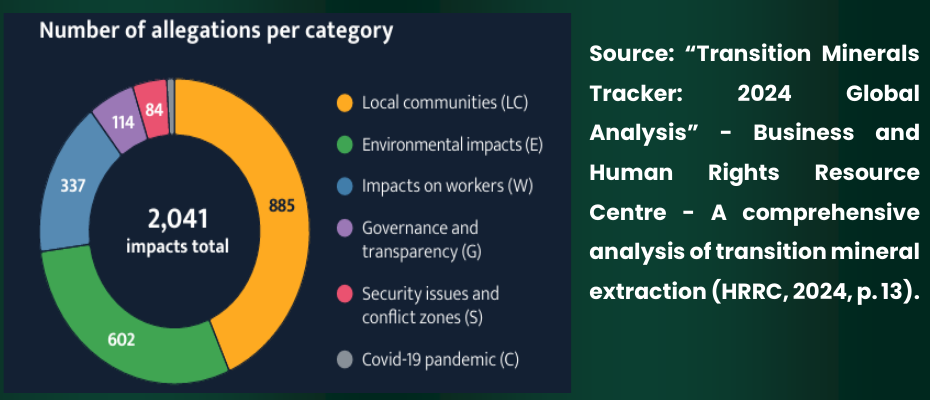
These limitations become especially visible in the discussion of transition minerals. While the report acknowledges the environmental and governance risks associated with the expanded mining of cobalt, nickel, lithium, and other critical minerals, it ultimately frames these minerals as necessary for the global energy transition and as potential development opportunities if managed responsibly. This analysis is strikingly incomplete. It disregards the extensive evidence of human rights abuses, child labor, gendered violence, displacement, and conflict dynamics associated with mineral extraction in countries such as the Democratic Republic of Congo (Testimony of Ida Sawyer, 2022).
Text extracted from the illustration
Source: “Transition Minerals Tracker: 2024 Global Analysis” - Business and Human Rights Resource Centre - A comprehensive analysis of transition mineral extraction (HRRC, 2024, p. 13).
The DRC and the Harsh Realities of the Green Transition
Field evidence from the Democratic Republic of Congo (DRC), one of the largest sources of cobalt and copper in the world, tells a more troubling story. Recent studies by civil society organizations directly challenge the optimistic narrative of the Bank. In “Beneath the Green”, RAID and AFREWATCH document how the cobalt boom has inflicted “devastating human and environmental impacts” on local communities (RAID, 2024, p. 1). Contrary to claims that the DRC cobalt is clean or sustainable, villagers report chronic pollution and health problems that have a serious gender dimension (Ibidem). Over half (56%) of local women report gynecological and reproductive health problems, and 72% report chronic skin diseases after contact with contaminated water (Ibidem).
The report is focused on testimonies from the local communities that show the disconnect between the Bank’s global model and local reality. RAID’s research involved 144 interviews across 25 villages near five major mines in Kolwezi (a mining hub), revealing overwhelming evidence of water and soil contamination. Nearly all respondents (99%) who farm fish said yields had dramatically declined due to polluted water (Idem, p. 47). Economic hardship follows: about 59% of families have had to cut their food to one meal a day, and 75% can no longer afford medical care (Idem, p.2). In short, where the World Bank sees mining as an opportunity for jobs and growth, affected DRC communities experience a “sacrifice zone”, as UN experts say, where environmental and health damages accumulate under heavy industrial activity (Idem, p.15).
Mining firms did install boreholes to supply drinking water, but RAID found these fell short of basic standards. None of the companies met the DRC regulations or even the World Health Organization’s minimum of 20 liters per person per day (Idem, p. 55-60). Thus, residents still lack safe water despite lucrative mining profits in their midst.
These findings underscore that toxic pollution from industrial cobalt mining is indeed a reality for communities in the DRC, directly contradicting the idea that supply-chain transparency or company rhetoric ensures a true “clean” energy transition. The World Bank report argues that data and accountability can mitigate mining’s risks, but in practice, the regulatory system in the DRC has broken down. RAID notes that the country has robust environmental laws on paper, yet government agencies are too under-resourced to enforce them (Idem, p. 67-71).
In parallel, Amnesty International’s “Powering Change or Business as Usual?” highlights how mining expansion has displaced communities outright. The report documents dozens of cases in Kolwezi, where entire villages and farms were evacuated for new mine projects, often without fair compensation or resettlement. Amnesty finds that forced evictions are now a systemic issue, affecting most residents of mining-affected areas (Amnesty International, 2023, p. 6). Communities are trapped between mining projects, driven from their land with no meaningful avenues. This is happening despite national laws intended to protect people’s homes: the DRC government has failed to implement and enforce existing laws (Idem, p. 48). In some documented cases, authorities even carried out or facilitated the evictions, rather than preventing them. As Amnesty warns, while Congolese cobalt is essential for the global shift away from fossil fuels, many companies are expanding with little regard for the rights of these communities (Idem, p. 90-91).
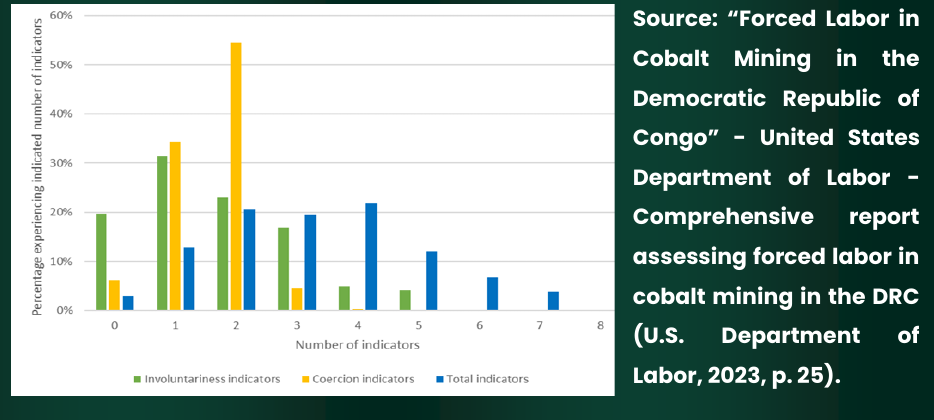
Research also shows how children in the DRC are more likely to work in the mining sector rather than go to school, with some starting as young as twelve and working without protective equipment while exposed to toxic dust or tunnel collapse (Faber et al., 2020, pp. 32-44; Godelive et al., 2023, pp. 75-78; Malpede, 2025, pp. 22-23). These findings are not marginal to the green transition: cobalt from such sites feeds directly into global battery production. Similarly, RAID shows that industrial companies routinely rely on subcontracting and informal labor arrangements that externalize risks onto unprotected workers, enabling abusive practices while maintaining plausible deniability (RAID, 2021, pp. 25-37). By omitting these labor dynamics, the World Bank presents a sanitized version of the transition minerals sector that does not reflect how extraction actually occurs in high-demand contexts.
Text extracted from the illustration
Source: “Forced Labor in Cobalt Mining in the Democratic Republic of Congo” - United States Department of Labor -Comprehensive report assessing forced labor in cobalt mining in the DRC (U.S. Department of Labor, 2023, p. 25).
The Human Costs of Environmental Degradation
This type of analysis also fails to interrogate the ethical and political implications of powering Western decarbonization through intensified extraction in the Global South. By presenting improved governance and transparency as sufficient remedies, the report minimizes the structural violence embedded in current mineral supply chains and underestimates the degree to which green transitions risk reproducing the same patterns of resource dependence that have long shaped global development (Amnesty International, 2023; Juliane, 2024).
Finally, the report pays insufficient attention to the social and gendered dimensions of environmental harm. Communities living near mines, forests, and degraded agricultural areas (particularly women, children, displaced people, and those in conflict-affected regions) experience environmental degradation not only as an economic loss but as profound disruptions to daily life, security, health, and bodily autonomy (Brück et al., 2024, pp. 1840-1842).
These lived realities are not meaningfully represented in the report, which remains oriented toward macroeconomic trends and national policy frameworks rather than the granular social effects of ecological change. The report argues that environmental and social harm can be mitigated if laws are enforced and governance is strengthened. However, the existence of practices such as child labor or exploitative subcontracting is precisely evidence that formal governance solutions alone cannot address structural incentives in global supply chains.
Between Progress and Continuity
In sum, The Economics of a Livable Planet constitutes a significant step in the World Bank’s engagement with the ecological crisis. Its empirical rigor, systems approach, and recognition of the economic importance of environmental stability represent meaningful progress. Yet, the report remains encumbered by the enduring features of the intellectual architecture of the Bank: a commitment to perpetual growth, a technocratic understanding of governance, a reluctance to confront global power asymmetries, and a tendency to depoliticize structural drivers of environmental destruction. Recognizing these tensions is not to dismiss the value of the report, but to highlight the distance between acknowledging ecological limits and transforming the political-economic model that continues to undermine them.
References:
• Amnesty International. (2023a). Powering Change or Business as Usual? (No. Index Number: AFR 62/7009/2023). Amnesty International. https://www.amnesty.org/en/documents/AFR62/7009/2023/en/
• Amnesty International. (2023b, September 11). Forced evictions at industrial cobalt and copper mines in the DRC. Amnesty International. https://www.amnesty.org/en/latest/news/2023/09/drc-cobalt-and-copper-mining-for-batteries-leading-to-human-rights-abuses/
• Arora, S., & Stirling, A. (2023). Colonial modernity and sustainability transitions: A conceptualisation in six dimensions. Environmental Innovation and Societal Transitions, 48, 100733. https://doi.org/10.1016/j.eist.2023.100733
• Brück, T., Hanmer, L. C., Klugman, J., & Arango, D. J. (2024). Gender Dimensions of Forced Displacement: A Brief Review and Introduction to the Special Issue. The Journal of Development Studies, 60(12), 1839-1851. https://doi.org/10.1080/00220388.2024.2376145
• Cerkini, B., Bajrami, R., & Bajraktari, K. (2025). Relative and Absolute Decoupling: Conceptual Confusions, Policy Consequences, and a Multi-Level Synthesis. Economies, 13(11), 336. https://doi.org/10.3390/economies13110336
• Chagnon, C. W., Durante, F., Gills, B. K., Hagolani-Albov, S. E., Hokkanen, S., Kangasluoma, S. M. J., Konttinen, H., Kröger, M., LaFleur, W., Ollinaho, O., & Vuola, M. P. S. (2022). From extractivism to global extractivism: The evolution of an organizing concept. The Journal of Peasant Studies, 49(4), 760-792. https://doi.org/10.1080/03066150.2022.2069015
• Dorninger, C., Hornborg, A., Abson, D. J., Von Wehrden, H., Schaffartzik, A., Giljum, S., Engler, J.-O., Feller, R. L., Hubacek, K., & Wieland, H. (2021). Global patterns of ecologically unequal exchange: Implications for sustainability in the 21st century. Ecological Economics, 179, 106824. https://doi.org/10.1016/j.ecolecon.2020.106824
• Faber, B., Krause, B., & Sánchez de la Sierra, R. (2020). Delve | Artisanal Mining, Livelihoods, and Child Labor in the Cobalt…. Delve. https://www.delvedatabase.org/resources/artisanal-mining-livelihoods-and-child-labor-in-the-cobalt-supply-chain-of-the-democratic-republic-of-congo
• Godelive, K. B., Martin, D., & Nene, M. M. B. (2023). Small-scale mining and child labor in Kolwezi, Democratic Republic of Congo. Journal of African Studies and Development, 15(4), 69-83. https://doi.org/10.5897/JASD2023.0679
• Hickel, J., & Kallis, G. (2020). Is Green Growth Possible? New Political Economy, 25(4), 469-486. https://doi.org/10.1080/13563467.2019.1598964
• HRRC. (2024). Transition Minerals Tracker: 2024 Global Analysis. Business & Human Rights Resource Centre. https://www.business-humanrights.org/en/from-us/briefings/transition-minerals-tracker-2024-global-analysis/
• Juliane, K. (2024, July 10). Mining for the Energy Transition Needs to Respect Human Rights. Human Rights Watch. https://www.hrw.org/news/2024/07/10/mining-energy-transition-needs-respect-human-rights
• Kallis, G., Hickel, J., O’Neill, D. W., Jackson, T., Victor, P. A., Raworth, K., Schor, J. B., Steinberger, J. K., & Ürge-Vorsatz, D. (2025). Post-growth: The science of wellbeing within planetary boundaries. The Lancet Planetary Health, 9(1), e62-e78. https://doi.org/10.1016/S2542-5196(24)00310-3
• Karakaya, E., Alatas, S., Erkara, E., Mert, B., Akdoğan, T., & Hiçyılmaz, B. (2023). The Rebound Effect of Material and Energy Efficiency and Their Determinants: Insights from the Stochastic Frontier Analysis for the EU and its Major Trading Partners (SSRN Scholarly Paper No. 4501943). Social Science Research Network. https://doi.org/10.2139/ssrn.4501943
• Kramarz, T., & Momani, B. (2013). The World Bank as Knowledge Bank: Analyzing the Limits of a Legitimate Global Knowledge Actor. Review of Policy Research, 30(4), 409-431. https://doi.org/10.1111/ropr.12028
• Malpede, M. (2025). The Dark Side of Batteries: Cobalt Mining and Children’s Education in Sub‐Saharan Africa. International Economic Review, iere.70001. https://doi.org/10.1111/iere.70001
• RAID. (2021). The Road to Ruin? Electric vehicles and workers’ rights abuses at DR Congo’s industrial cobalt mines. RAID-UK. https://raid-uk.org/post-library/the-road-to-ruin-electric-vehicles-and-workers-rights-abuses-at-dr-congos-industrial-cobalt-mines/
• RAID. (2024). Beneath the Green: A critical look at the cost of industrial cobalt mining in the DRC. RAID. https://raid-uk.org/post-library/report-beneath-the-green/
• Testimony of Ida Sawyer. (2022, July 14). Child Labor and Human Rights Violations in the Mining Industry of the Democratic Republic of Congo | Human Rights Watch. https://www.hrw.org/news/2022/07/14/child-labor-and-human-rights-violations-mining-industry-democratic-republic-congo
• U.S. Department of Labor. (2023). Forced Labor in Cobalt Mining in the Democratic Republic of the Congo. https://www.dol.gov/sites/dolgov/files/ILAB/DRC-FL-Cobalt-Report-508.pdf