
Article text
In general terms, public participation can be understood as “the involvement by a local population and, at times, additional stakeholders in the creation, content, and conduct of a program or policy designed to change their lives (Jennings, 2001)”. This definition connects its relevance to the field of human development, which can be understood as “the betterment of humankind achieved through the alleviation of poverty and the realisation of human potential by enlarging people's choices” (Cowen and Shenton, 2005, p. 25). As the previous implies that people should possess access to capabilities that can help them create the life that they want to value, one can see the interconnection between the two concepts, arguing in favour of the necessity of using public participation in order to better understand and tackle the multifaceted dimensions of development.
The variety of actors that are to be involved in the development initiatives may often complicate the efforts made in order to set the priorities straight and coordinate the actions of each individual towards reaching specific goals. But at the end of the day, the efforts should be done in the benefit of the targeted people, this is why their voices should be the ones to be heard first and give the final feedback. As a result, the government and authorities in charge of development initiatives have the responsibility to empower people to contribute and influence a decision that is about to impact their daily lives. However, certain critics vehiculating in the public space accuse public participation of being a manifestation of appeasing the public with the idea that their input and voices matter when in reality they don’t.
Supporting the argument that efficiently done development initiatives call for local input and representation from various societal sectors and actors while answering to the needs and priorities of the members of society, in the following analysis I will address certain shortcomings of public participation to argue that, despite its flaws and critics, it is indeed a beneficial democratic and development process for both the decision makers and the beneficiaries involved.
“Public participation is a manipulation tool”
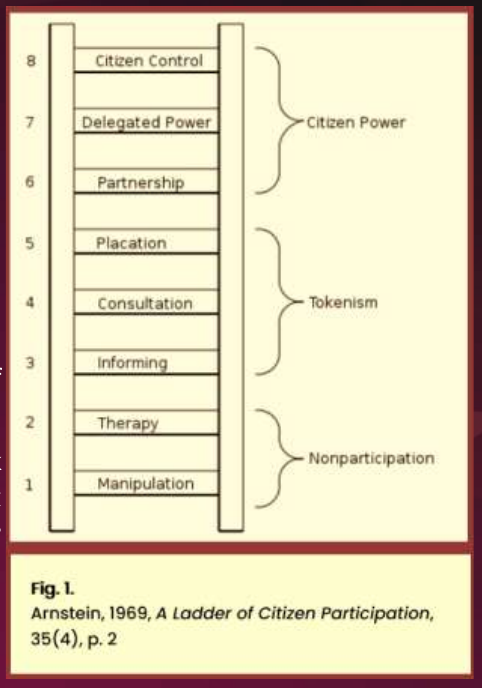
One prominent argument is that public participation is a manipulation tool serving in the benefit of the decision makers, an orchestrated illusion of citizen empowerment, allowing the one in power to direct the final outcome that the project is moving to, fitting a preexisting agenda. In order to combat this argument, I shall take a look into the steps that one should follow when doing public participation, presented in a suggestive manner of a ladder of participation.
In 1969, Sherry Arnstein published her book on “A Ladder of Citizen Participation”, a work which, according to some authors, “forever changed how planners, communities, and governments think about citizen participation” (Burke, 1971). Her research was based on her experience at the Department of Housing and Urban Development (HUD) as the chief advisor on citizen participation in the Model Cities Program. Although a bit old, it is still considered a cornerstone contribution in the field of public participation and community development (Gaber, 2019).
Sherry identifies eight levels of participation, where each ladder corresponds to a specific outcome generated by the level of power that is transferred to the citizens through public engagement. The first two levels, “Manipulation” and “Therapy” are characterized as levels of non-participation, where the public process is done so that one can say the participation was part of the decision. The manipulation appears when citizens are made to believe that their input matters when, in reality, it is not at all valued or taken into consideration. The therapy refers to starting the participation process on the premise that citizens need to be educated or “cured”, not recognising them as capable individuals that valuably provide useful insights, "adjusting their values and attitudes to those of the larger society" (Arnstein, 1969, page 5). Thus, these two levels serve more authority in power than the public, implying an illusion of citizen empowerment and contribution when, in reality, decision-makers are actually the only ones in power.
Arnstein calls the following sections of “Informing” and “Consultation” the levels of “tokenism”, where citizens are provided with a certain opportunity to voice their opinions but are still limited due to the fact that they have no guarantee that their input will actually affect the decision that is to be made. Using a one-way flow of information without room for a response will notify the citizens about the decision already made without opening discussion for possible adaptations of the plan. Their opinion may be heard but not acted upon. The same is true for consultation, where, although their opinions and feedback are required, without meaningful follow-through, it will not ensure that their input actually matters or that it will influence anything. As Sherry mentions, they only “participated in participation” (Arnstein, 1969, page 6), also quoting a response received from a woman living in a ghetto neighbourhood: “Nothing ever happens with those damned questions, except the surveyor gets $3 an hour, and my washing doesn't get done that day. In some communities, residents are so annoyed that they are demanding a fee for research interviews” (Arnstein, 1969, page 6).
Reaching the “Placation” level is where citizens begin to have a certain degree of influence, although tokenism is still present. Hand-picking representatives is one placation strategy where the ones meant to represent the voice of the community are specially targeted without ensuring that they are representative or accountable for the broader community. Another strategy often used is creating advisory committees. While those provide the context for the citizens to offer their input, they limit the representation of the community in terms of diversity and fail to address inclusive recommendations in relation to the community’s needs and interests.
It is only at the “Partnership” stage that the public participation process gets closer to its main goal, namely citizen empowerment. Here, the power is redistributed between the authorities and the citizens through various forms of dialogue and negotiation. This collaborative approach allows for shared decision-making and a fair distribution of power and influence by finding common ground and making sure that the final outcome should not be the case for a unilateral decision-making process. The partnership leaves room for a higher level of “Delegated Power”, empowering citizens with decision-making authority and, depending on the specificity of the initiative, adding some managerial responsibility. Delegated power arrangements can create collaborative efforts of creating and managing the respective project or initiative by designating some of the responsibilities towards the involved citizens without being overruled by external actors. This position also gives them the possibility to oversee the decisional and implementation process, ensuring accountability and transparency. Eventually, the higher level of public participation that can be reached is the one of “Citizen Control”. This stage doesn’t imply that the power is entirely shifted from the authorities towards the public, but it increases the public role in a decisional process that, in the alternative of being ruled only by “outsiders”, may misjudge or overlook important ground-level issues and perspectives (Arnstein, 1969).
In the beginning of Arnstein’s argument, information and therapy (education) are identified as manipulation tools. In addition, I clarify the following in my own perspective: As presented by the ladder analogy itself, informing and educating the public are the ground parts for any participation process. As the public needs to get educated and informed, the problems and wrongdoings can occur when a public mobilization process that wants to pass through as participation involves only informing and educating actions. In other words, the manipulation accusations appear if the decision makers are resuming these two stages, stopping the participation process before actually beginning and resuming it to what they consider relevant enough to help check the participation component. My argument is that a process that doesn’t move higher through all the stages of the participation ladder cannot be considered a process of public participation, since the former is a multi-step journey.
“Public participation is too time and resource consuming”
An often-met argument is that public participation is too costly in terms of time and financial resources. However, some opinions may support the contrary. Through the figures bellow, Creighton (2005) illustrates the length of time used in unilateral decision making versus decision with public participation, regarding stages of decision-making and implementation. Both approaches cover three important stages: identification of the problem, decision-making moment and the implementation process.
Unilateral decision-making implies that the problem is identified faster without gathering any additional input from the public. This is misleading the authorities into believing that skipping consultation with the public will speed up the process and will help save time and money that otherwise would be spent on organizing conferences and workshops with the public. In reality, all the skipped steps increase the chances of encountering more struggles and problems along the way that could have been prevented if the local knowledge had been addressed. The lengthy curb in the diagram illustrates how the time saved by a hasty decision will transform into a long, complicated process, encountering unforeseen impediments that may have been avoided from the beginning with proper consultation from others. As Creighton also suggests, unilateral decision-making is the quickest to be decided upon but usually ends up as one of the most expensive to implement.
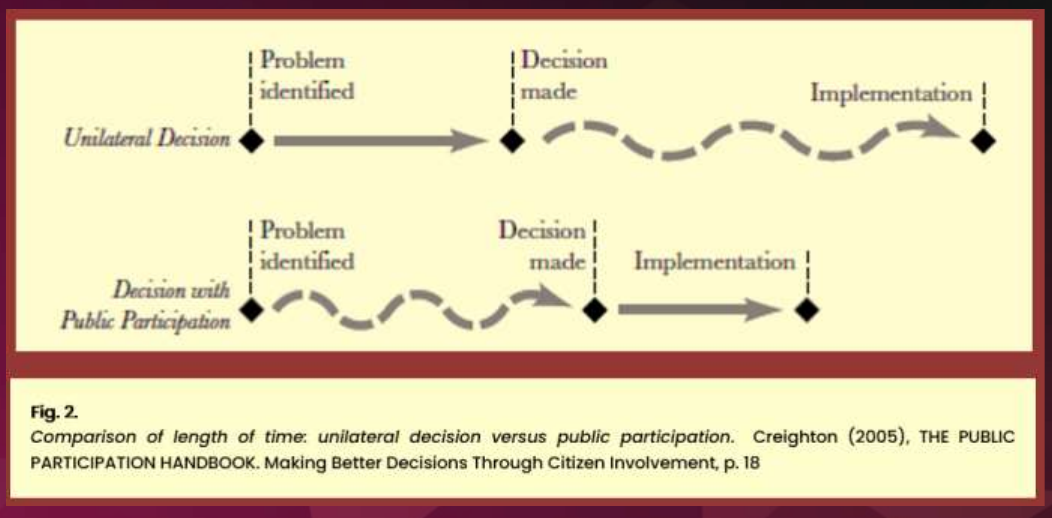
On the other hand, decisions made with public participation manifest great benefits. Firstly, “the public can force a rethinking of hidden assumptions that might prevent seeing the most effective solution.” (Creighton, 2005, p. 18). The views of the public often provide fresh perspectives that may be overlooked by the authorities, missing crucial information about the reality of the field that could make the difference between a successful or failed project. Secondly, the use of public participation actually minimizes the costs and delays caused by how the decision was made. As shown by the diagram above, allocating the necessary measures to address the problem step by step from multiple perspectives will eventually show its benefits in the form of a smooth implementation.
Concluding this argument with what Creighton himself explains (2005, page 18), not applying public participation doesn’t show any positive gains in terms of time recourse, as “unilateral decisions are always the quickest to make but often very expensive to implement. Frequently, there is so much resistance that they are never implemented at all”. In other words, integrating the participation component into the decisional process doesn’t take as much time as some may think.
“Some question the legitimacy of the locals. Resistance to change”
The following criticism is not addressed towards the participation process itself but rather towards the ones through which the process is done: the public. A general criticism is that, depending on the community and the prospect of the initiative, there are cases when some may question the legitimacy of the locals.
In order to better understand this, I created this example I would like to describe and explore in the this section. Let’s imagine that a group of authorities has the initiative to build a school for children residing in remote areas. Most of them are currently facing struggles to go to the school in the nearest village, the distance being too big and with no availability for means of transportation. The project (be it proposed directly by a local authority or through an external donor) is feasible in terms of land, infrastructure resources and teachers’ availability. However, after discussions and hearings with the members of the community, the local authorities encountered the following issue: the majority of the locals are against building the school. Some of the identified reasons include: most of the children are already engaged in agricultural and housework activities, assisting their parents; the older boys already started working small jobs around the village to earn some money and as for the girls, they don’t need to go to school in order to fulfil their future roles of becoming mothers and housewives.
What should the authorities do? If they ignore the input gathered from the public and build the school anyway, there are high chances that children will not be able to attend, while the parents may be angered by not being taken seriously. But if the authorities follow the voice of the locals, what will happen with the right to education of all those children left behind? What will their future look like? This example is meant to challenge the idea that public participation doesn’t always fit into initiatives that strike for genuine development. As a response, an improved public participation strategy with higher chances of success may look like this: While undergoing direct meetings and hearings between the initiating authorities and the public, one needs to keep in mind at any step of their approach that they are working with a traditional society with deeply rooted values and principles. This implies the need to provide comprehensive information adapted accordingly to the local customs and perceptions within that respective society while also striving for innovation. For this case, additional focus should be applied towards informing on the immediate and long-term benefits of children pursuing education, including the betterment of their current and future economic situation. This can also be done by organizing pilot workshops in nearby schools to show the children and the parents the benefits of schooling that their peers enjoy. Here, the authority in charge can provide some economic incentives to motivate the parents’ approval, easing some of the financial challenges of sending children to school (providing school uniforms, stationeries, offering meal programs, transport means or even another form of aid for the families whose children prove to attend school regularly).
Secondly, after getting a grasp of the first reactions, further meetings, consultations and public engagement should focus on the specific concerns of the locals regarding the subject. If the parents are worried that the school will be a detriment in the time schedule allocated to prioritised household activities, the authority in charge of the project may come up with a specially tailored flexible schedule that aligns, for example, with the local agriculture practices. While challenging certain “traditions” (ex: combating the idea that girls should not go to school), one way to reduce resistance towards innovation is by adapting the curricula to enhance the feeling that school is an extension of the cultural values rather than an imposition (ex: local history and heritage, both intellectual and agrarian skills, ethical teachings on respecting the elders and other elements articulated through the local customs and traditions). This is a good way of manifesting sensibility to what parents consider to be the current needs and priorities of their children, laying the foundation for a good start and striving towards educational progress, step-by-step, little by little.
In conclusion, fostering meaningful public participation can indeed create stronger communities, improve the collaboration between the authorities and the citizens and generate sustainable development. To ensure that public participation is more than a superficial exercise, decision-makers must commit to moving beyond tokenism and genuinely empower citizens to get involved. This requires careful consideration of local contexts, transparent communication, and an adaptive approach that integrates public input at every stage. When done correctly, public participation has the capacity to address not only immediate community needs but also foster long-term development and resilience.
Bibliography
• Arnstein, S. R. (1969). A Ladder Of Citizen Participation. Journal of the American Institute of Planners, 35(4), 216–224. https://doi.org/10.1080/01944366908977225.
• Burke, B. (1971). Threat to Citizen Participation in Model Cities. Cornell Law Review, 56(5), 751–778.
• Creighton, J. (2005). The Public Participation Handbook: Making Better Decisions Through Citizen Involvement. https:// www.semanticscholar.org/paper/The-Public-Participation-Handbook%3A-Making-Better-Creighton/449c52876481bf32eee34f9682a82442dd35a319.
• Cowen, M. and Shenton, R. (2005) The Invention of Development, 2, Development Ethics, Michael Cowen. https:// www.taylorfrancis.com/chapters/edit/10.4324/9781315258003-2/invention-development-michael-cowen-robert-shenton (Accessed: 20 May 2024).
• Gaber, J. (2019). Building “A Ladder of Citizen Participation”: Sherry Arnstein, Citizen Participation, and Model Cities. Journal of the American Planning Association, 85(3), 188–201. https://doi.org/10.1080/01944363.2019.1612267.
• Jennings, R. (2001). Participatory Development as New Paradigm: The Transition of Development Professionalism. https://www.semanticscholar.org/paper/Participatory-Development-as-New-Paradigm-%3A-The-of-Jennings/4939fddb9fdf6cad3434314ecea5f32dc08b0ba6.